What Is a Covered Call ETF?
Understand covered calls and synthetic covered calls in under 60 seconds.
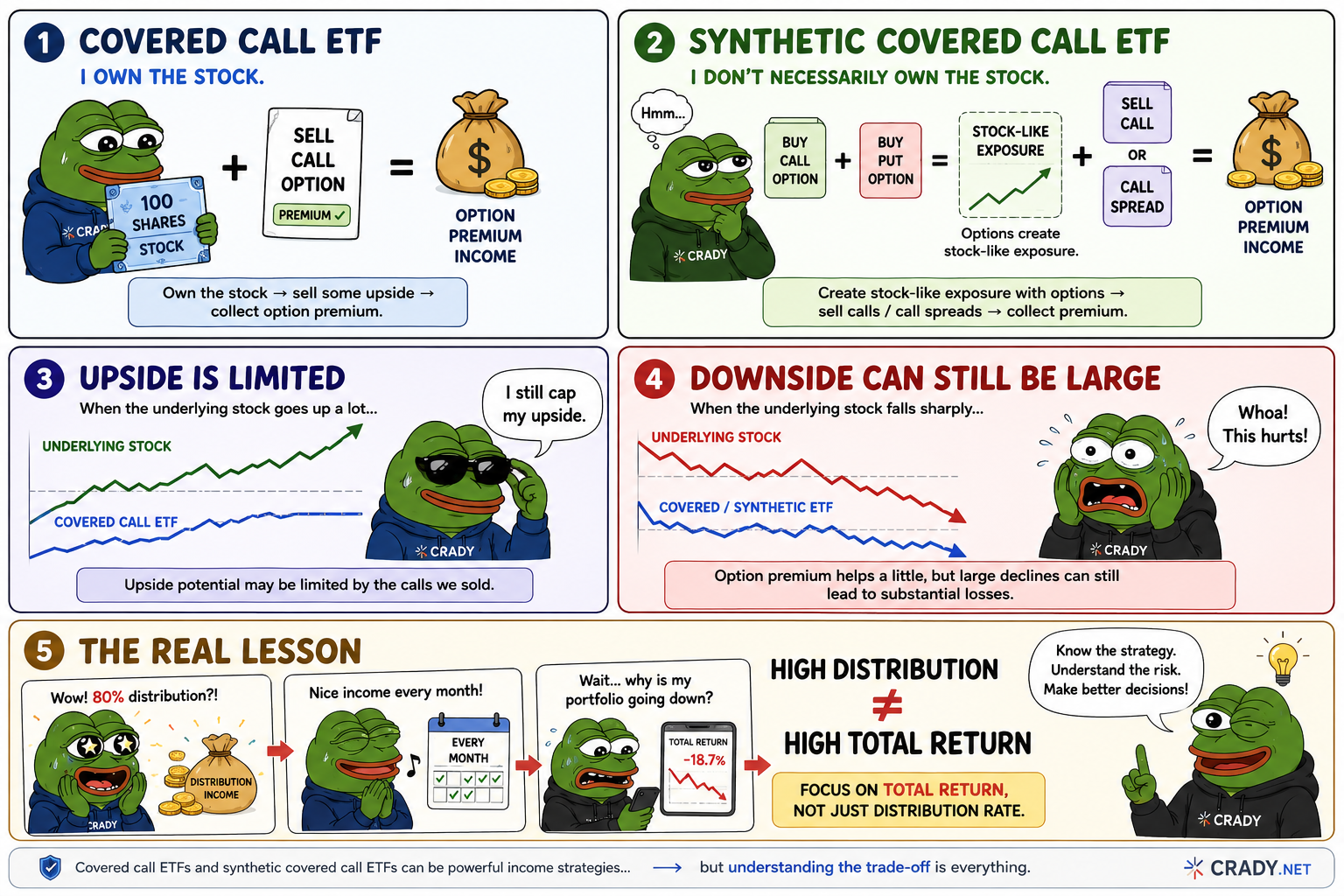
Covered call vs. synthetic covered call in under 60 seconds. Video coming soon.
What Is a Covered Call ETF?
A covered call ETF is an exchange-traded fund that holds stocks or other securities and sells ("writes") call options against that exposure. The option premium collected from selling those calls becomes a source of income the fund can distribute — a different mechanism from a typical dividend ETF, whose payouts usually come from dividends its underlying companies already pay out, not from selling options.
A synthetic covered call strategy can use options to create stock-like exposure instead of directly owning the underlying asset. It may then sell calls or call spreads to generate income.
Both structures can produce significant distributions, but substantial downside risk can remain.
Upside may be limited while downside risk can still be substantial.
Know the strategy. Understand the risk. Look at total return.
Covered Call ETF vs. Synthetic Covered Call ETF
Traditional Covered Call
- Fund owns the underlying shares
- Sells call options against those holdings
- Receives option premium as income
Synthetic Covered Call
- Uses options to create stock-like exposure
- Doesn't necessarily own the underlying shares directly
- Sells calls or call spreads to generate option premium
| Covered Call ETF | Synthetic Covered Call ETF | |
|---|---|---|
| Own underlying asset? | Usually yes | Not necessarily |
| Exposure | Direct ownership | Options can create stock-like exposure |
| Income | Call-option premiums | Option-selling strategies such as calls or call spreads, depending on the fund |
| Upside | May be limited by sold calls | May be limited by the option structure |
| Downside | The underlying asset can still fall substantially | Synthetic exposure can also suffer substantial losses |
| Complexity | Lower | Higher |
A note on YieldMax: YieldMax funds are a common example of the synthetic structure above, but YieldMax uses more than one option-income design — not every YieldMax ETF works identically. See how YieldMax ETFs work before assuming two of its funds behave the same way.
Why Do Investors Use Covered Call ETFs?
The main appeal is income. Selling call options generates option premium upfront, which can fund frequent — often weekly or monthly — cash distributions that are typically larger than what a traditional dividend-paying stock or fund offers.
That premium income can be especially useful in a flat or moderately rising market: even if the underlying asset doesn't move much, the fund can still generate meaningful income simply from selling options period after period.
Curious how that actually plays out for a real fund? Try the ETF Return Calculator → to see how a covered-call ETF has actually performed, including price change and distributions.
What Are the Risks?
- Upside can be limited. Selling calls typically means giving up some gains beyond the option's strike price.
- The underlying asset can still decline significantly. Option premium does not eliminate downside risk — a covered call ETF's share price can fall substantially even while it keeps paying distributions.
- A high distribution yield does not automatically mean a high total return. Distributions are only one side of the ledger; share-price or NAV movement is the other (see below).
- Distributions can change significantly from period to period, since they largely track option premium, which moves with volatility.
- Some distributions may include return of capital (ROC), depending on the fund — money that isn't investment income but instead reduces your cost basis.
Want to weigh several funds side by side? Compare Covered-Call ETFs →
How Does This Relate to YieldMax?
YieldMax is known for option-income ETFs with high, eye-catching distributions. It's easy to assume these funds simply own stocks and pay out large dividends — in reality, most YieldMax ETFs use a synthetic covered call strategy: they build stock-like exposure entirely out of options, rather than owning the underlying shares.
The exact structure varies by fund — option tenor, strike selection, and even whether a fund uses plain short calls or a call spread differ from ticker to ticker. Some YieldMax funds also target underlyings you can't buy directly on the stock market at all. Understand the specific fund you're looking at rather than assuming every YieldMax ETF behaves the same way. See the YieldMax ETF Guide for the general mechanics, or browse TSLY, MSTY, and NVDY — three widely-followed YieldMax funds tracked on CRADY — for a specific fund's own data.
Why Are Covered Call ETF Distributions So High?
Selling options can generate substantial option premium. That cash flow can support frequent or large distributions — but a distribution is not automatically investment profit.
An investor can receive large cash distributions while the ETF's share price or NAV declines. That's why it's worth adding up both sides of the ledger:
Cash distributions + Share-price / NAV movement = Overall investment result (total return)
(Illustrative only — not a real fund. For example: a fund distributing 10% of its price over a year while its share price also fell 15% would have a negative total return that year, despite the double-digit distribution rate.)
Part of a distribution can also be classified as return of capital (ROC) — money that isn't taxed as income but instead reduces your cost basis. Not every distribution is ROC, and the mix varies by fund and by year; check each fund's own reporting rather than assuming one way or the other.
Before Investing, Ask These 4 Questions
Frequently Asked Questions
A covered call ETF holds an underlying asset — a stock, an index, or a basket of stocks — and sells ("writes") call options against that holding. The premium collected from selling those options is the main source of the fund's often very high distributions.
It collects option premium upfront when it sells call options, regardless of what the underlying does afterward. That premium, combined with any price return or loss on the underlying position, makes up the fund's total performance.
Not exactly — most covered call ETFs pay "distributions," not dividends in the traditional sense. A dividend is normally a company sharing its own earnings; a covered call ETF's distributions are mainly funded by option premium income, plus any dividends its underlying holdings happen to pay. The two words get used interchangeably in everyday conversation, but the underlying source of the cash is different.
A fund that creates stock-like exposure using options — typically a combination of long calls and short puts — instead of directly owning the underlying shares, then sells calls or call spreads against that synthetic position to generate income.
A traditional covered call fund usually owns the underlying shares outright and sells calls against them. A synthetic covered call fund builds stock-like exposure entirely out of options instead of owning the shares, then sells calls or call spreads against that synthetic position.
Yes. Selling calls caps some upside, but it doesn't remove downside risk — if the underlying asset (or the fund's synthetic exposure to it) falls substantially, the fund's share price can fall substantially too, even while it keeps paying distributions.
Their distributions are largely funded by option premium income, which can be substantial — especially on volatile underlyings, since higher volatility generally means richer option premiums. A high distribution reflects that premium income, not necessarily strong total investment performance.
No. Most YieldMax funds do use a synthetic covered call strategy, but the exact option structure varies fund to fund — some use call spreads or other option-income structures instead. Check each specific fund's own strategy rather than assuming every YieldMax product works identically.
Not necessarily as well as owning the underlying directly. Because sold calls cap upside beyond a strike price, a covered call fund typically captures less of a sharp rally than the underlying asset itself, in exchange for the option income it collected.
It depends on the objective. If the goal is current income and the investor understands that upside can be capped and the underlying can still decline, a covered call ETF can fit that objective. If the goal is maximizing long-term total return, it's worth comparing the fund's actual total return — not just its distribution rate — against simpler alternatives, since capped upside can be a real long-term trade-off.
Browse actual covered call and synthetic covered call ETFs, with live CRADY scores and dividend predictions.
Want the deeper dive — NAV erosion, return of capital, and tax treatment? See the full Covered Call ETF Guide.
This page is for educational purposes only and is not investment advice.